An outside rectangle cannot tell you whether a cat has enough interior room or whether you can service the machine. The measurement tool and 22-model table record these questions separately. The worked examples below use Whisker Litter-Robot 4 and PETKIT PURA MAX 2 P9902. It never supplies a missing cat limit or turns partial measurements into an overall match.
What to measure
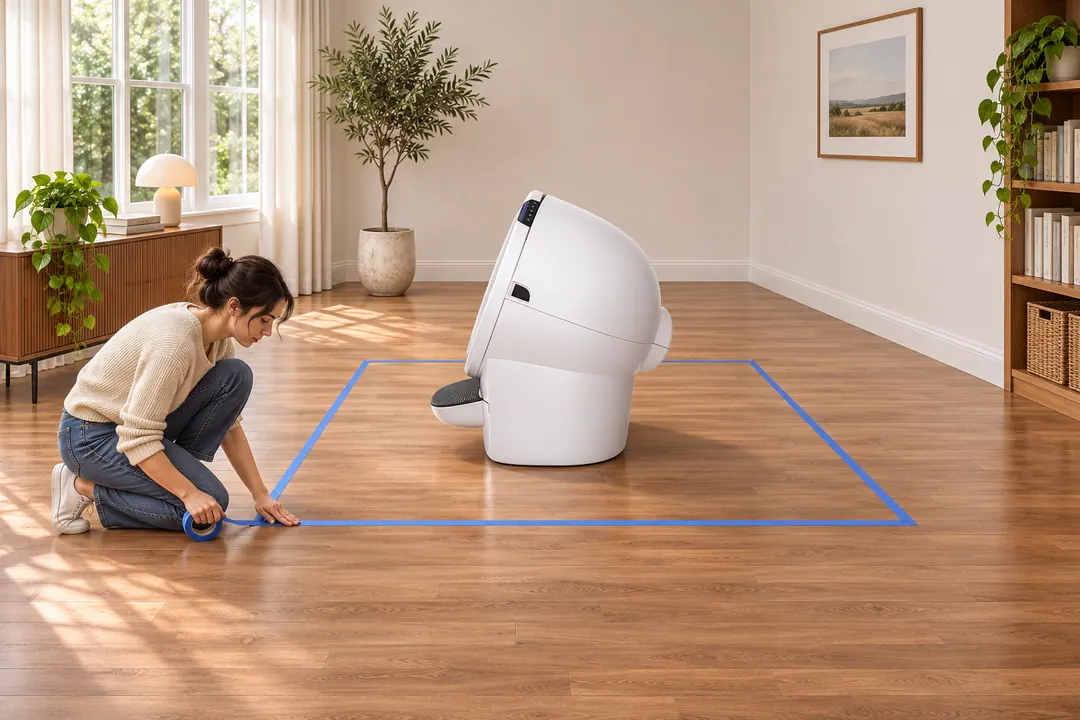
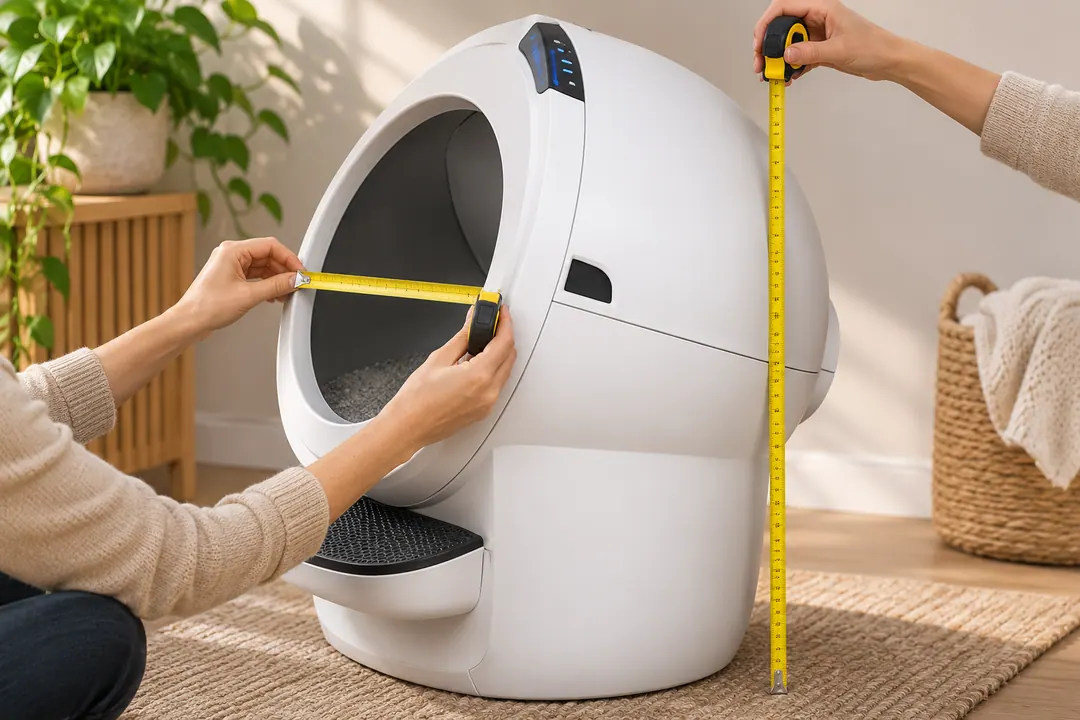
Record width across the intended front, depth behind the entrance and height above the floor in inches. Those numbers are compared only with the corresponding published outside body dimension. A positive difference is remaining space before any service allowance; zero means contact at that dimension, not usable clearance. The tool does not rotate the appliance or change its entrance direction.
Then use the litter-box layout planner to record drawer removal, doors, approach, servicing and actual manual requirements. An unknown side allowance stays unknown. A measured body does not establish an unobstructed route for the cat.
Two exact model records
| Measurement | Litter-Robot 4 | PURA MAX 2 P9902 |
|---|---|---|
| Outside body | 22 W × 27 D × 29.5 H in | Manual: 620 × 538 × 552 mm; axis order unresolved here |
| Usable interior | Globe 19 W × 18 D × 15–17 H in, depending on litter level | Not established by this source |
| Litter bed | 14 × 14 in | Not established |
| Entry | Opening 15.75 × 15.75 in; floor-to-entry 12 in | Not established |
| Optional step | Top 6.9 in above floor; not the entry height | No measurement established |
| Cat restriction | Manual minimum 3 lb for automatic mode; product page says 3–25 lb but FAQ says no upper limit | Older than 6 months; below 1.5 kg not recommended; upper weight unknown |
Source measurements are not our own tests. Check the exact current unit, accessories and manual before ordering. P9902’s old product URL now resolves to a different model, PUROBOT MAX 3; that newer model cannot fill the missing measurements in this table. Whisker’s upper-weight statements conflict, so no LR4 upper cutoff is imposed. Its current carpet guidance also differs from the manual’s firm, level surface requirement; confirm the setup with Whisker. P9902’s Amazon listing also displays dimensions different from the manual. Resolve that discrepancy directly before a tight installation.
Worked boundaries
- LR4 in a 22 × 27 inch space: the width and depth differences are both zero. The manual says the unit must not touch walls; the rectangle does not establish wall gaps or drawer access.
- A 7-inch entrance limit: LR4’s optional step top is 6.9 inches, but the floor-to-entry measurement is 12 inches. Neither number is a promise that a particular cat can enter comfortably.
- A 10 lb, 12-month-old cat with P9902: the recorded age and minimum-weight conditions can be met while upper weight, usable interior and cat acceptance remain unknown. The tool does not invent a 19 lb or 22 lb ceiling.
Do automatic litter boxes fit big cats?
Most makers do not publish the number that matters for a long cat: the usable floor length inside the box. Of the 22 models in the finder , only two publish an inside floor size: the Litter-Robot 3 Connect (a 20 by 20 inch globe) and the Litter-Robot 4 (19 by 18 inches). Twelve publish an entrance measurement, and eight record an upper cat weight, from 19 lb (Litter-Robot EVO) to 33 lb (Neakasa M1 and M1 Lite, a recommendation the maker words as “around 33 lbs”). A weight limit says nothing about length.
The veterinary guidance on ordinary litter boxes is a length rule. The AAFP and ISFM house-soiling guidelines, as amended in 2018, say: “We recommend a rectangular litter box that is 1.5 times the length of the cat from nose to base of tail; in one study, adult cats preferred a box that was 34 × 15 inches (86 × 39 cm) over a smaller one.” (erratum record on PubMed ). It is written for rectangular boxes. Applying its ratio to a round globe is our arithmetic, not the guideline’s statement.
| Model | Inside floor, as the maker publishes it | Longest cat, nose to base of tail, that a 1.5 times floor allows |
|---|---|---|
| Litter-Robot 3 Connect | 20 × 20 in (FAQ) | 13.3 in |
| Litter-Robot 4 | 19 × 18 in (manual) | 12.0 to 12.7 in, depending on which side the cat’s length runs along |
| The other 20 models | Not published | Cannot be calculated |
A cat longer than the figure in the last column would need a longer floor under the guidance. Measure your own cat from nose to base of tail rather than guessing from weight. Where the maker publishes no inside floor, the honest answer is “ask the maker”, and the table above does not guess. The full specification table is available as a CSV, with the source page for every row. Makers revise limits, so each row was checked on November 8, 2026 and should be rechecked quarterly.
Method and limits
All input fields except model are optional. Blank values stay unknown; edits immediately clear old results. Pounds convert to kilograms using exactly 0.45359237 kg/lb for the P9902 minimum. P9902’s axis order is not established, so its millimeter tuple is shown as source information and is not used to approve a room dimension. Exactly 6 months does not prove P9902’s “older than 6 months” scope.
The tool does not calculate household box sufficiency, litter compatibility, odor, noise, reliability or individual animal suitability. It has no invented upper weight, assumed cat-count capacity, price ranking or overall score. Original product picks remain in the self-cleaning litter-box guide ; room constraints for a small bathroom need more than a small footprint.
Sources and exact listings
Checked November 3, 2026. As an Amazon Associate, we earn from qualifying purchases. Listing identity does not establish current stock, seller or price.